

Fall Tree and Shrub Care in Virginia: How to Protect Your Ornamentals Before Winter
Fall is the most important season for your trees and shrubs, and most homeowners spend it raking instead of caring for them. As the weather cools, trees and shrubs stop putting energy into leaves and shift it into their roots, which makes autumn the ideal time to set them up for a strong spring. A little attention now pays off far more than the same effort in July. This guide covers what fall tree and shrub care actually involves in Virginia, the mistake that wastes most homeowners' money, and how to know when a professional program is worth it.
Quick Answer
Fall is the best time to care for trees and shrubs in Virginia because plants move their energy into root growth once top growth slows. The most useful fall steps are a soil test, improving the soil around the roots, protecting plants from overwintering insects, and watering deeply until the ground freezes. Skip the reflex to dump fertilizer on a struggling plant, since most tree and shrub problems in Northern Virginia come from soil and site issues, not a lack of nutrients.
Why Fall Is the Right Time for Tree and Shrub Care
Fall is the right time for tree and shrub care because plants redirect their energy underground as the season cools. Once leaves drop and top growth slows, trees and shrubs focus on building roots and storing energy for the following year. Work done in the root zone now, from soil conditioning to deep watering, reaches the plant when it can actually use it.
The same principle drives fall lawn care, which is why the two go hand in hand. Virginia Cooperative Extension calls autumn the "OPTIMAL time to aggressively fertilize cool-season turfgrasses," because cooler air and warm soil push root development. Your ornamentals follow a similar rhythm, so fall is when root-focused care makes the biggest difference for both the lawn and the landscape.
Timing does come with a caution for trees and shrubs. Heavy nitrogen applied in late summer or very early fall can push tender new growth that will not harden off before frost. That is why good fall care leans on soil building, root feeding at the right time, and pest protection rather than a big shot of quick-release fertilizer.
The Myth That Costs Homeowners the Most
The most expensive tree and shrub mistake in Northern Virginia is assuming a struggling plant simply needs fertilizer. When a shrub yellows or a tree thins out, the instinct is to feed it. In many local yards, that does nothing, because the real problem is below the surface.
Northern Virginia is full of disturbed suburban soil. Virginia Cooperative Extension notes that urban and suburban soils are often "heavily compacted, poorly aerated, poorly drained, and low in organic matter" after construction. A plant sitting in compacted clay with poor drainage cannot use extra fertilizer, and piling more on can even make things worse. Fixing the soil, the drainage, and the planting depth solves far more problems than another bag of fertilizer ever will.
How to Care for Trees and Shrubs This Fall
Fall tree and shrub care works best as a short sequence: understand the soil, fix the soil, feed the roots, and protect the plant through winter. Each step builds on the one before it.
- Start with a soil test. A soil test tells you what your plants actually need instead of guessing. Fall is the ideal time to run one, because Virginia Cooperative Extension explains that "sampling in the fall allows time for corrective pH and nutrient management" before spring growth begins. For trees and shrubs, sample the soil in the beds to a depth of about six inches, after pulling back any mulch.
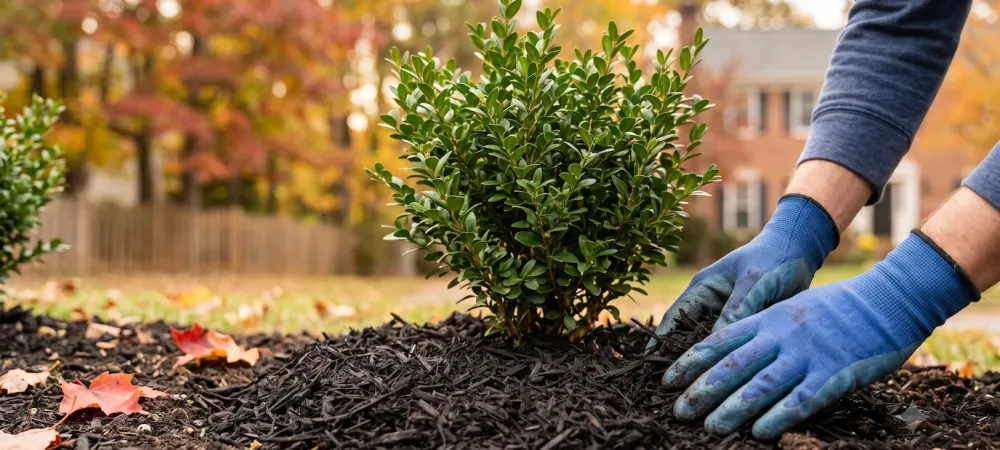
- Improve the soil around the roots. Address compaction and low organic matter before adding nutrients. A layer of mulch two to three inches deep over the root zone, kept off the trunk, holds moisture and slowly builds soil as it breaks down. On compacted beds, loosening the soil and adding organic matter does more for long-term health than fertilizer alone.
- Feed the roots at the right time. Root-zone feeding in fall supports the growth happening underground, but timing and rate matter. Because early-fall high-nitrogen feeding can push tender growth, the safer approach is a balanced, root-directed application later in the season once plants are heading toward dormancy. This is where professional deep-root feeding placed directly in the root zone outperforms a broadcast product sitting on the surface.
- Protect against overwintering insects and disease. Many tree and shrub pests spend winter as eggs or adults tucked in bark and buds. A dormant or horticultural oil application smothers overwintering insects and their eggs before spring, which is the first step in NuLeaf's plant health care program. Fall is also when spotted lanternflies lay eggs on trunks, so this is a natural time to check and treat host trees.
- Water deeply until the ground freezes. Trees and shrubs still need water in fall, especially evergreens that lose moisture all winter. A deep soak every week or two through late fall, tapering as the ground freezes, helps roots go into winter strong.
Fall Care Versus Spring Care, and DIY Versus Professional
Fall and spring both offer real benefits for trees and shrubs, but they serve different goals. Fall care is about roots, soil, and winter protection, setting the plant up quietly for the year ahead. Spring care is about supporting the flush of new growth and catching early-season pests. For established plants in tough suburban soil, fall is usually the higher-value season because it works with the plant's natural root cycle.
The DIY-versus-professional choice comes down to the tools and the diagnosis. A homeowner can mulch, water, and remove obvious pests with good results. What is harder to do alone is read a soil test correctly, place nutrients deep in the root zone, and identify a disease or insect before it spreads. A professional program covers the parts that require training and equipment:
- Diagnosing whether the issue is soil, water, pests, disease, or planting
- Deep-root feeding and soil conditioning placed where roots can reach it
- Correctly timed insect and disease control across the season
- Ongoing monitoring so small problems get caught early
Prevention Tips for Healthy Trees and Shrubs
Long-term tree and shrub health in Virginia is mostly about consistent, low-effort habits:
- Keep mulch two to three inches deep and pulled back from the trunk, never mounded against it.
- Water deeply and less often to build deep roots, rather than shallow daily sprinkling.
- Prune dead or damaged branches, but avoid heavy pruning in fall that can spur tender growth.
- Watch for early signs of trouble, such as thinning canopies, off-color leaves, or sticky residue from pests like crape myrtle bark scale.
- Run a soil test every few years so you are feeding based on facts, not guesses.
When to Call a Professional
Call a professional when a tree or shrub is declining and you cannot tell why, or when you want a program that protects your ornamentals across the whole year. Early warning signs are easy to miss until real damage is done, and by then options narrow. If your plants matter to your property's appearance and value, they are worth an expert eye.
NuLeaf's Plant Health Care program is a 7-step approach built around the roots, covering soil conditioning, nutrients and biostimulants, insect pest management, and disease management, with free diagnostic testing to pinpoint what each plant needs. Our certified team nurtures your trees and shrubs through every season instead of reacting after damage shows. Fall is the right time to get started, because the work you do now is what your plants draw on next spring.
Take the Next Step
Fall tree and shrub care is the quiet work that decides how your landscape looks next year. Test the soil, build the root zone, protect against overwintering pests, and keep watering until the ground freezes. Do that, and you will spend less time fixing problems in the spring. If a plant is struggling and you are not sure why, we can help you find the real cause instead of guessing.
Not sure what your trees and shrubs need heading into winter? Call Nuleaf Lawn Care at 703-989-9405 and we will help you figure out the right next step.
Sources
-
"Fertilizing Landscape Trees and Shrubs." Virginia Cooperative Extension, Publication 430-018, Virginia Tech, pubs.ext.vt.edu/430/430-018/430-018.html.
-
"Soil Sampling for Residential Areas." Virginia Cooperative Extension, Publication 452-129, Virginia Tech, pubs.ext.vt.edu/452/452-129/452-129.html.
-
"Fall Fertility Strategies for Virginia's Homelawns." Virginia Cooperative Extension, Virginia Tech, ext.vt.edu/lawn-garden/turfandgardentips/tips/fall-fertilization-2007.html.