

Spotted Lanternfly in Northern Virginia: What to Do When You See Them This Fall
If you are seeing gray, spotted bugs clustered on your trees, fences, or deck this fall, you are almost certainly looking at spotted lanternflies. They are an invasive pest that has spread across Northern Virginia over the last few years, and late summer through fall is when adults are most active and most visible. The good news is they do not bite people or pets, and a healthy yard can recover from them with the right response. This guide walks through how to identify them, what to do right now, and when it makes sense to bring in a professional.
Quick Answer
Spotted lanternflies are an invasive planthopper active in Northern Virginia from mid-July through the first hard frost. They do not sting or bite, but they stress trees and plants by feeding on sap and coating leaves in sticky "honeydew" that grows black mold. The best response this time of year is to scrape and destroy egg masses through winter, treat heavily used host trees, and call a professional if the population on your property is large.
What Spotted Lanternflies Are and Why They Matter in NOVA
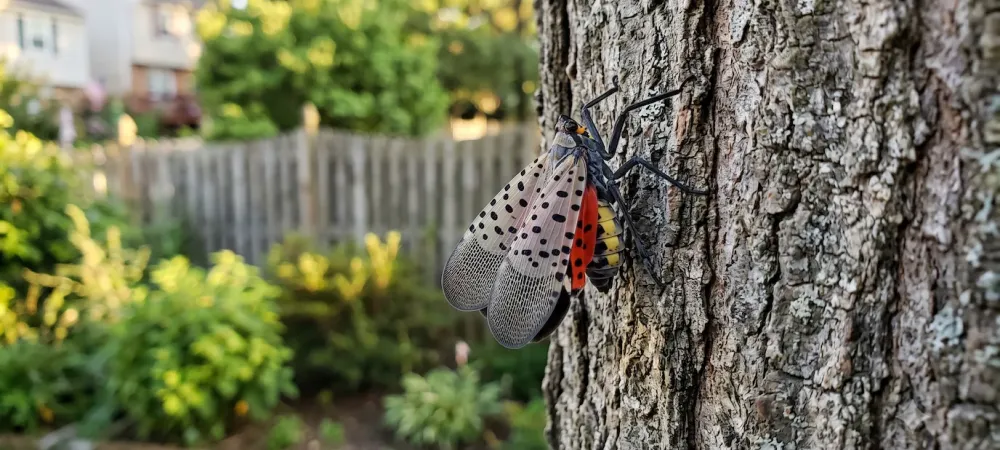
Spotted lanternflies are an invasive insect first confirmed in Virginia in 2018 that has since spread across most of the state, including the Northern Virginia suburbs. Adults are about an inch long with gray forewings, black spots, and bright red underwings. According to Virginia Tech News, "adult spotted lanternflies are active from mid-July to October," which is exactly the window when homeowners start noticing them in large groups.
Spotted lanternflies matter because of how they feed, not because they are dangerous to your family. They pierce stems and trunks to drink sap, which weakens the plant, and they excrete a sugary waste called honeydew that coats leaves, decks, and cars. That honeydew grows a black, sooty mold and draws in wasps and ants, the same sooty mold you see with crape myrtle bark scale. Grapevines and young trees are at the highest risk, while established shade trees are usually stressed rather than killed.
One important update many homeowners miss: the reporting rules have changed. Virginia Cooperative Extension confirms that "the Virginia Spotted Lanternfly Quarantine was repealed in March 2025." You no longer need to report sightings if you live in an area where the pest is already established, which covers most of Northern Virginia. A lot of older advice online still references that old quarantine, so it pays to work from current guidance.
How to Handle Spotted Lanternflies on Your Property
Handling spotted lanternflies comes down to three moves: identify the stage you are dealing with, remove what you can by hand, and protect the plants they target most. Timing matters because the pest looks completely different depending on the month.
- Confirm what you are seeing. In late summer and fall, adults gather on tree trunks, fences, and outdoor furniture, often in groups. By fall they shift toward laying eggs. Virginia Cooperative Extension notes that egg masses look like a "shiny grey, waxy protective covering" over rows of eggs, and they show up on trunks, fences, rocks, and equipment. Learning to spot egg masses is the single most useful skill for long-term control.
- Remove adults and egg masses directly. Adults can be knocked into a container of soapy water. Egg masses can be scraped off with a plastic card or putty knife into a bag or a container of hand sanitizer or alcohol, then sealed and thrown away. Each egg mass you destroy in fall and winter is 30 to 50 fewer lanternflies next spring, so this quiet off-season work has an outsized payoff.
- Protect the trees they swarm. Spotted lanternflies strongly prefer a few host plants, especially the invasive tree-of-heaven, along with grapevines and some maples. If you have a tree that draws heavy activity, that is where professional treatment does the most good. Do not move firewood, outdoor furniture, or yard items with egg masses on them, since that is how the pest spreads to new neighborhoods.
Different Ways to Control Spotted Lanternflies
There is no single method that clears spotted lanternflies in one pass, so most successful control combines a few approaches. Each option fits a different situation.
Hand removal works well for small numbers and for egg masses in reachable spots. It costs nothing but your time, and it is the most reliable way to reduce next year's population. The limit is obvious: you can only reach so high, and a heavy infestation will outpace a putty knife.
Targeted insecticide treatment works when a specific host tree is drawing large groups. Trunk sprays and systemic treatments applied by a trained applicator reduce feeding pressure on the plants that matter most. This is where professional plant health care earns its keep, because product choice, timing, and placement all affect whether the treatment helps or just knocks back a few bugs.
Circle traps are a middle option for catching nymphs and adults as they climb a trunk. A funnel-style circle trap guides the insects into a container without any adhesive. Be careful with the old sticky-band trick, though. Uncovered sticky bands can trap birds, squirrels, and beneficial insects, which is why Penn State Extension recommends circle traps, or a wildlife barrier over any sticky band you do use.
Prevention Tips for Long-Term Control
Prevention with spotted lanternflies is really about denying them a foothold season after season. A few habits make a real difference:
- Scrape and destroy egg masses on your property every fall and winter, before they hatch in spring.
- Remove tree-of-heaven from your property where possible, since it is their favorite host and a magnet for the pest.
- Check vehicles, trailers, patio furniture, and grills before moving them, especially if you travel between counties.
- Keep trees and shrubs healthy, because a vigorous plant tolerates feeding stress far better than a weak one. Fall tree and shrub care is the easiest way to build that resilience.
- Watch grapevines and young ornamentals closely, as these take the most damage.
When to Call a Professional
Call a professional when the number of spotted lanternflies on your property is more than you can manage by hand, or when they are swarming a tree you want to protect. A few dozen bugs on a fence is a scrape-and-move-on situation. Hundreds clustered on a mature tree, sticky honeydew coating your deck, or black mold spreading on leaves are signs the population has outgrown DIY control.
NuLeaf's Spotted Lanternfly Control handles this through targeted, professionally applied treatment as part of our plant health care approach, which focuses on protecting the trees and ornamentals these pests target most. Our certified team can identify the host plants driving the activity on your property and treat them correctly, so you are not guessing at products or timing. If you are already seeing heavy activity this fall, that is the right time to get on a plan before egg-laying builds next year's population.
Take the Next Step
Spotted lanternflies are a nuisance you can get ahead of, especially if you act during the fall egg-laying window. Scrape the egg masses, protect your host trees, and keep your plants healthy, and you will see fewer of them each year. If the activity on your property has gotten out of hand, we can help you sort out what is worth treating and what is not.
Dealing with spotted lanternflies at your place, or just not sure what you are looking at? Call Nuleaf Lawn Care at 703-989-9405 and we will help you figure out the right next step.
Sources
-
"Now Entering Their Adult Phase, Spotted Lanternflies Are Headed into Their Invasive Peak." Virginia Tech News, Virginia Tech, news.vt.edu/articles/2024/07/cals-spotted-lanternfly-july-adults.html.
-
"Homeowner Suggestions for Managing Spotted Lanternfly." Virginia Cooperative Extension, Publication ENTO-586, Virginia Tech, pubs.ext.vt.edu/ENTO/ento-586/ento-586.html.
-
"Spotted Lanternfly in Virginia." Virginia Cooperative Extension, Virginia Tech, ext.vt.edu/agriculture/commercial-horticulture/spotted-lanternfly.html.
-
"Spotted Lanternfly Circle Trap." Penn State Extension, The Pennsylvania State University, extension.psu.edu/spotted-lanternfly-circle-trap.